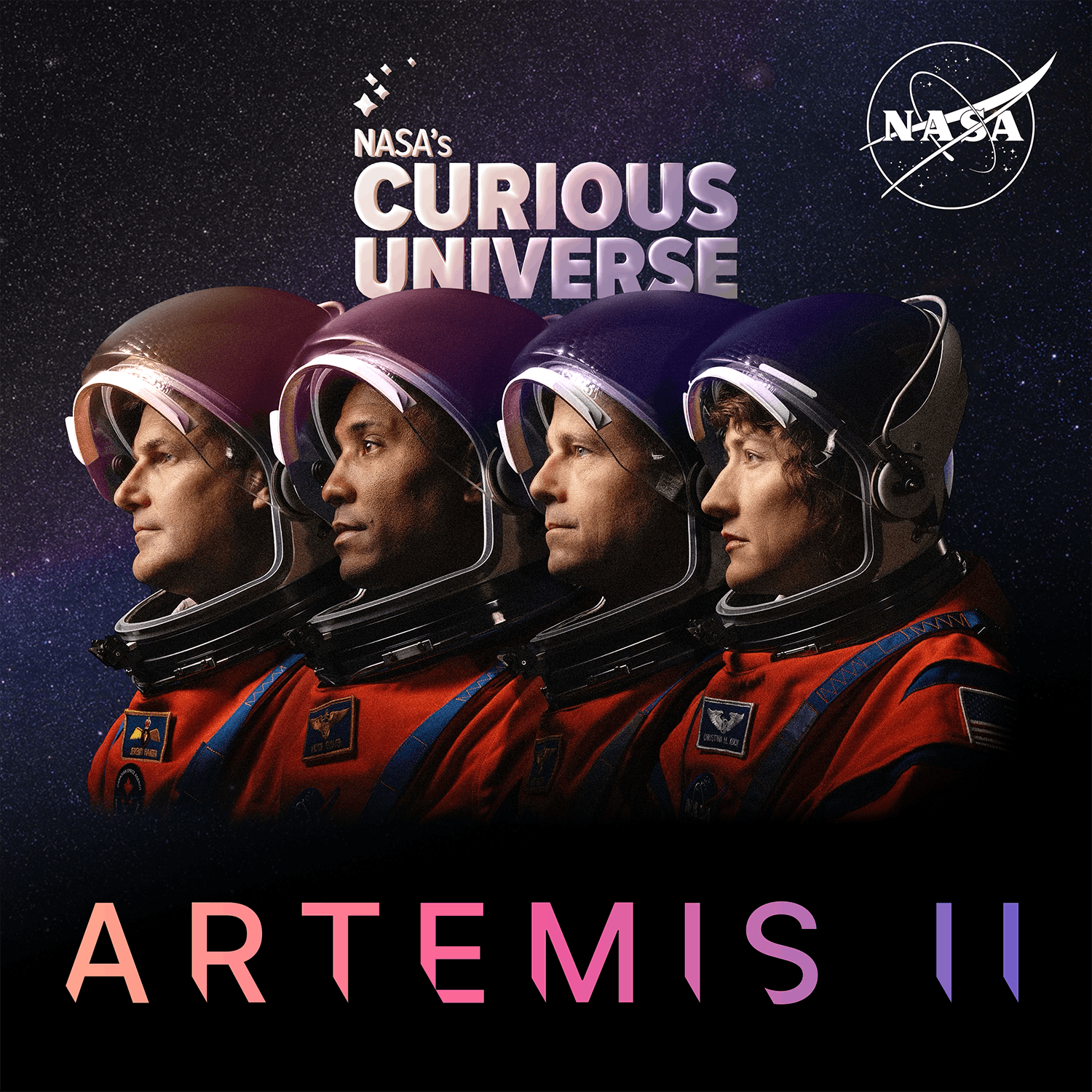
Launching Soon: Artemis II
This year, four NASA astronauts are flying around the Moon and back—and Curious Universe is bringing you along for the ride. The mission is called Artemis II. It’s a key test flight that will set t...
The James Webb Space Telescope is doing something astronomers dreamed about for decades: peering into our universe’s early past, a period known as cosmic dawn. A new NASA documentary—also called Co...
Have you ever dreamed of spending a day in space? Humans have lived aboard the International Space Station for 25 years—or more than 9,000 consecutive days. In this episode originally published in ...
In the space between stars, dark clouds of gas, dust, and ice mingle in a chemical laboratory unlike any on Earth. Ewine van Dishoeck, an astronomer who studies molecules in space and who helped de...
NASA’s James Webb Space Telescope is hard at work answering our biggest questions about the birth of our universe and faraway galaxies. But some astronomers are pointing its powerful eyes much clos...
Some exoplanets—like a gas giant with rain made of glass and 5,000-mile-per-hour winds—sound like worlds dreamed up by a science fiction writer. But they’re real. From light-years away, scientists ...
With the James Webb Space Telescope, we are seeing the early universe like never before. Webb produces beautiful images and detailed scientific data that leave astronomers in awe. In this episode, ...
In space, microgravity changes the body. Body fluids shift from the legs toward the head, the back of our eyes flatten, we lose muscle strength, our bones lose some of their density, and even the a...
NASA has a record of Earth observations going back more than 50 years. What might be in store for the next 50 years? In this finale of our Earth series, we hear from two sc...
Take a deep breath, and you’re inhaling oxygen from Earth’s atmosphere. Take a walk outside, and the atmosphere is shielding you from harmful radiation. NASA research provides crucial data to under...
Earth has an incredibly varied and ever-changing landscape—jagged mountains, arid deserts, lush rainforests, rolling wheat fields. Before NASA came on the scene, no one was keeping a systematic eye...
Life all over the planet—even far from the coasts—depends on the oceans. A pair of NASA satellites, PACE and SWOT, is giving us a fresh look at Earth’s water. PACE tracks color changes driven by ti...
NASA is an exploration agency, and one of our missions is to know our home. In the 1960s, NASA astronauts orbiting the Moon captured a revelatory view of Earth. Today, NASA explores our home p...
There’s one planet NASA studies more than any other: Earth. With our unique vantage point from space, NASA collects information about our home in ways nobody else can. In this podcast miniseries, c...
NASA has a long history of bringing together science, engineering and art. Space exploration is a human endeavor—one that requires creativity. In this special live episode, NASA astronaut Matthew D...
When it launched in 1990, NASA expected the Hubble Space Telescope to last for about 15 years. Thirty-five years later, Hubble is still showing us the universe as no other telescope can. Go behind ...
How did life begin? It’s one of science’s biggest questions, but it’s impossible to answer on Earth, where ancient clues have been buried by the planet’s shifting surface. Instead, scientists are l...
The Moon’s South Pole is a bizarre landscape. Mountain ridges glow in perpetual sunlight while deep craters freeze in billion-year-old shade. Yet hidden in the depths of those shadowed craters, und...
Black holes are mysterious, far away, and can bend the fabric of reality itself—but we're learning more about them all the time. Ronald Gamble, a NASA theoretical astrophysicist, uses math, compute...
As climate change drives more frequent and intense tropical cyclones and hurricanes, coastal communities desperately need better tools to predict how bad storms will be and when and where they’ll s...